
Local guide · 6 min read
Hard water and your Sub-Zero ice maker in the South Bay
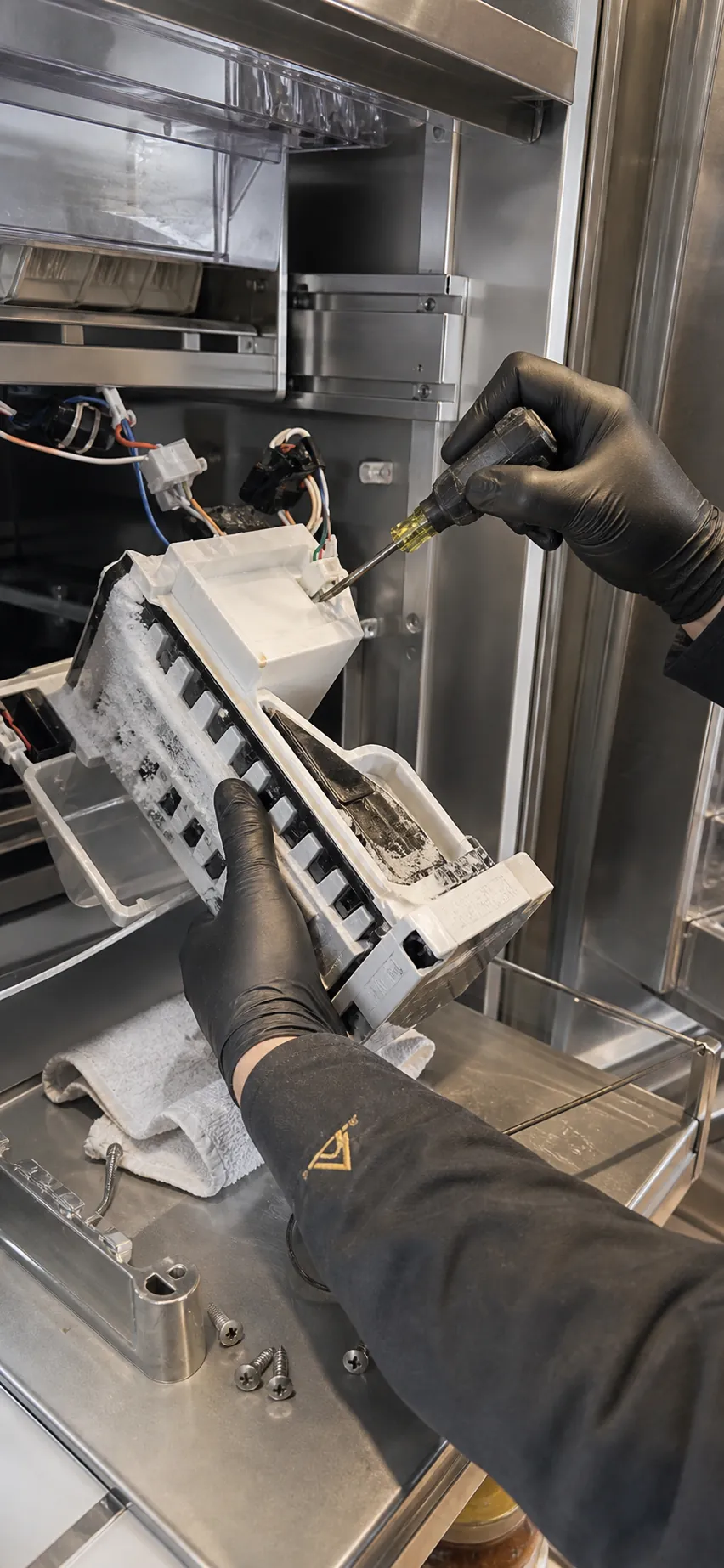
Water in much of San Jose and the surrounding South Bay runs hard — the Santa Clara Valley draws on groundwater and imported supply that carry a good deal of dissolved mineral. You taste it in the kettle and see it on the shower glass, and it is doing the same thing, slowly, inside your Sub-Zero ice maker.
Most of the ice-maker calls we run in Willow Glen, Almaden Valley and Cambrian Park trace back to scale long before they trace back to a failed part. Here is what is actually happening and how to read the early signs.
What hard water does to the ice circuit
Every batch of ice leaves a little mineral behind. Over months that deposit builds on the fill tube, the mold, and the thin water passages that feed the maker. The first thing you notice is the ice itself: smaller cubes, cloudy or hollow ones, or a tray that comes up only half full. Left alone, scale narrows the fill path until cycles stretch out and the maker eventually stops keeping up with the household.
The valley's mineral load makes this faster here than in soft-water regions. A unit that might coast for years elsewhere starts showing symptoms sooner in a San Jose kitchen, which is why we treat ice volume as a maintenance signal rather than an afterthought.
Signs worth acting on
Shrinking cube size and slower production are the honest early warnings. A faint white crust around the fill area, ice that smells faintly mineral, or a maker that runs but yields little are all consistent with scale rather than a dead module. Replacing the module on a scaled circuit just hands the new part the same problem, so the diagnosis matters.
We check the fill valve, the inlet path and the mold before we ever talk about a part, because on South Bay water the cheapest fix is usually descaling and a fresh water filter, not new hardware.
Staying ahead of it in San Jose
Change the Sub-Zero water filter on schedule — a clogged filter both worsens taste and starves the maker. Run the unit's clean or descale routine if your model supports it, and have the ice circuit looked at once a year alongside a condenser cleaning. Households on private wells in the Almaden foothills should treat that interval as a floor, not a target.
When scale has already done damage, a precise repair beats a blind part swap. If your ice has been shrinking for weeks, that is the moment to book a diagnosis rather than wait for the maker to quit on a holiday weekend.
Frequently Asked Questions
Is San Jose water really hard enough to affect a Sub-Zero ice maker?
Yes. Santa Clara Valley supply carries enough dissolved mineral to leave scale in the ice circuit over time, which is why South Bay ice makers tend to show shrinking cubes and slower output earlier than units on softer water.
Will a new water filter fix a slow ice maker?
Sometimes, if a clogged filter is starving the maker. But if scale has already built up in the mold or fill path, the filter alone won't restore output — the circuit needs descaling or a proper diagnosis first.
How do I book a diagnosis?
Call (650) 668-1172 or use our online booking link. The $89 service call is a flat on-site diagnosis fee, waived when you proceed with the repair.
Guides
More South Bay guides
Book Now
Schedule a Visit
Book online in minutes and choose a window that works for you.